
Guide
AI Playground: learn AI with free simulators and games
Reading about AI only gets you so far. These free websites let you play with it: train a model, look inside an LLM, explore how AI understands meaning, or try to outsmart it. Each one is labelled Easy, Medium or Advanced, so you can start simple and go deeper when you're ready. None of them needs payment.
- Easy: No maths or coding. Anyone can start in a minute.
- Medium: Some new ideas to take in; rewards a little curiosity.
- Advanced: Shows the real maths and inner workings. Best on a computer.
Start here: no maths needed
Quick, fun ways to see how AI learns from examples, and where it goes wrong.
Easy 10 minutes
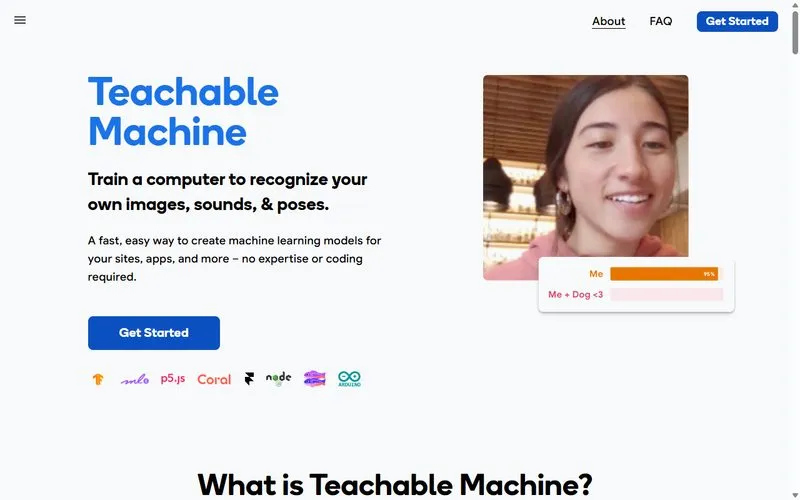
Teachable Machine
by Google · Free
Train your own AI to recognise images, sounds or poses using your webcam or microphone, with no coding.
You'll learn: How AI learns from examples, and why more varied examples make it better.
Try it →Easy 5 minutes
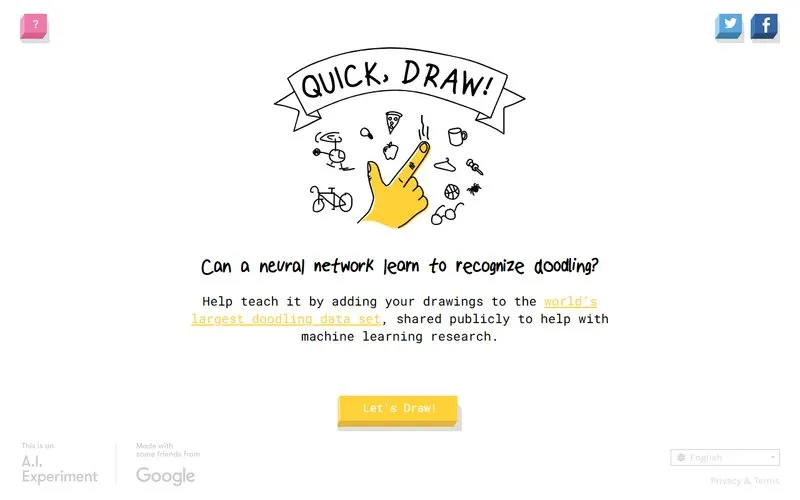
Quick, Draw!
by Google · Free
Doodle a word in 20 seconds while a neural network tries to guess what you are drawing.
You'll learn: How AI recognises patterns it has learned from millions of other people's drawings.
Try it →Easy About an hour
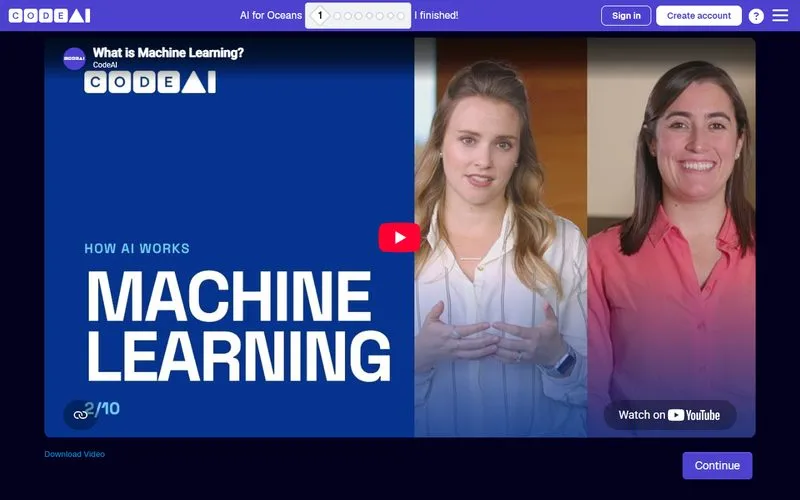
AI for Oceans
by Code.org · Free
Teach an AI to tell fish from rubbish in the sea, step by step, with short videos along the way.
You'll learn: Training data, and how the examples we choose can make an AI biased.
Made for school students, but good for any beginner.
Try it →Easy 5 minutes
Which Face Is Real?
by University of Washington · Free
Two faces side by side: one is a real photo, the other was made by AI. Pick the real one.
You'll learn: How convincing AI-generated images have become, and the small clues that can give them away.
Try it →Easy 10 minutes
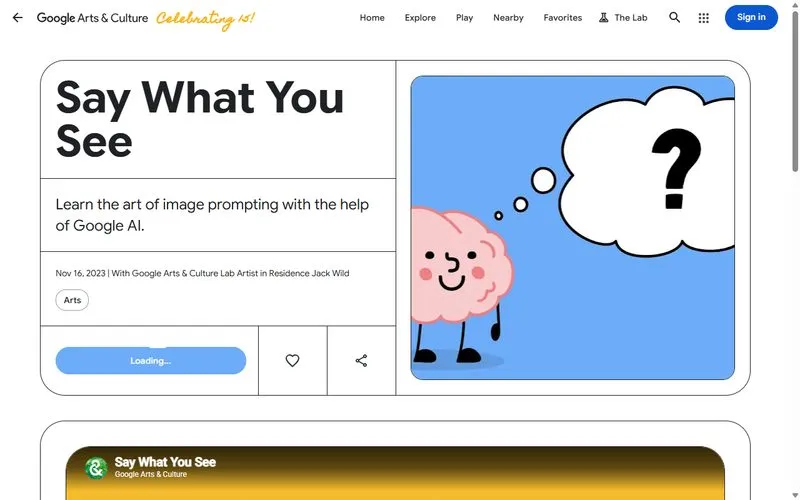
Say What You See
by Google Arts & Culture · Free
Look at an image and describe it so that Google's AI can recreate it as closely as possible.
You'll learn: How to write good prompts for image generators.
Try it →Easy 10 minutes
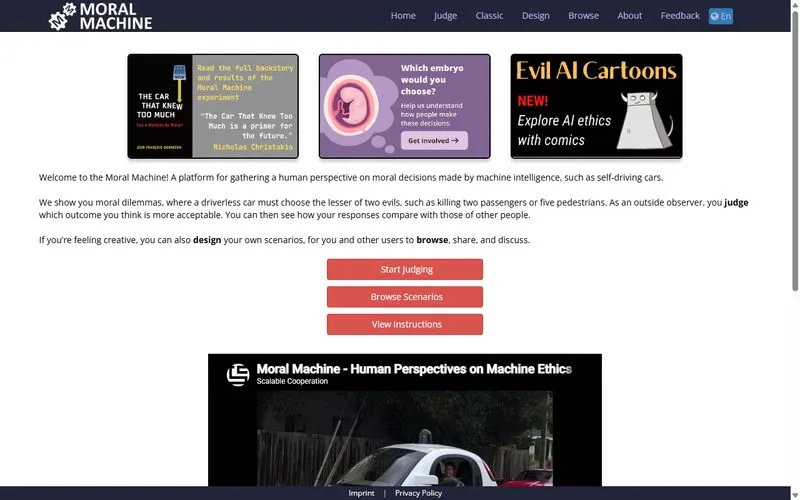
Moral Machine
by MIT Media Lab · Free
Decide what a self-driving car should do when a crash cannot be avoided, then compare your choices with people around the world.
You'll learn: Why giving machines moral rules is hard, and how much people disagree.
Try it →
How language models work
Look inside the technology behind ChatGPT, Claude and Gemini.
Easy 5 minutes
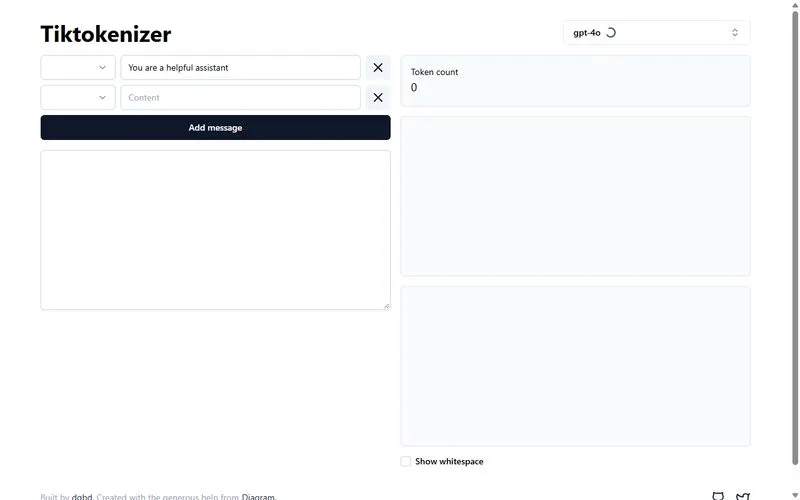
Tiktokenizer
by Independent open-source tool · Free
Type any text and see how an AI model splits it into tokens, with a running count.
You'll learn: What tokens are, and why long prompts and some languages cost more.
OpenAI also has its own tokenizer at platform.openai.com/tokenizer.
Try it →Medium 15 minutes
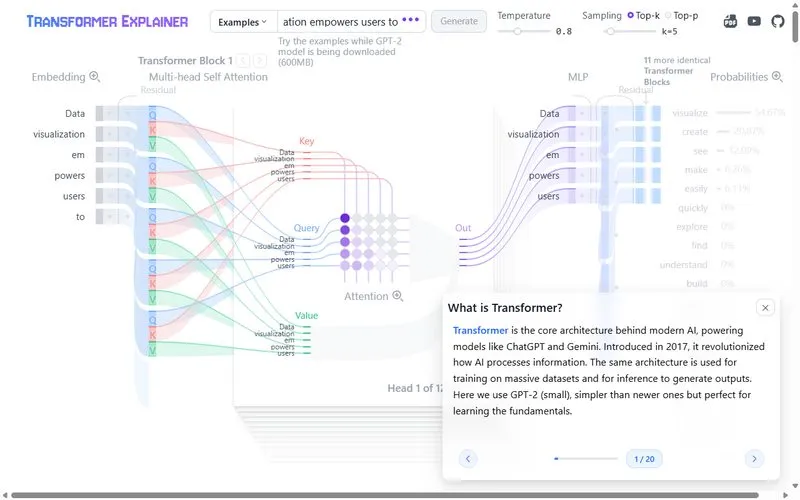
Transformer Explainer
by Georgia Tech (Polo Club) · Free
Run a real GPT-2 model in your browser, type a sentence and watch how it picks the next word. A temperature slider shows how randomness changes the answer.
You'll learn: How a language model predicts text, one token at a time.
Large language model (LLM)TemperatureToken
Try it →Advanced 30 minutes or more
LLM Visualization
by Brendan Bycroft · Free
A 3D animated walk-through of every calculation inside a small GPT-style language model.
You'll learn: What actually happens inside an LLM, layer by layer.
Best on a computer with a modern browser.
Large language model (LLM)ParametersNeural network
Try it →
Meaning, embeddings and RAG
How AI turns words into numbers that capture meaning, and how it looks up your documents.
Medium 15 minutes
Embedding Projector
by Google TensorFlow · Free
Explore a 3D cloud of 10,000 words placed by meaning. Search a word and see which words sit closest to it.
You'll learn: What embeddings look like, and why similar ideas end up near each other.
Best on a computer.
Try it →Medium 10 minutes
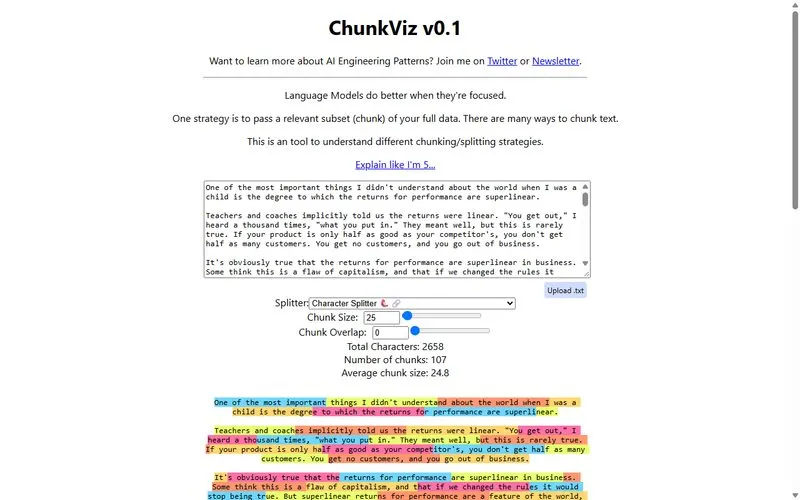
ChunkViz
by Greg Kamradt · Free
Paste a document and see, in colour, how it gets cut into chunks, the first step in building a RAG system. Change the chunk size and overlap to compare.
You'll learn: How AI tools prepare your documents before searching them.
RAG (retrieval-augmented generation)
Try it →
Prompting, safety and AI risk
Learn how AI can be tricked, and why controlling it is harder than it sounds.
Medium 20 minutes
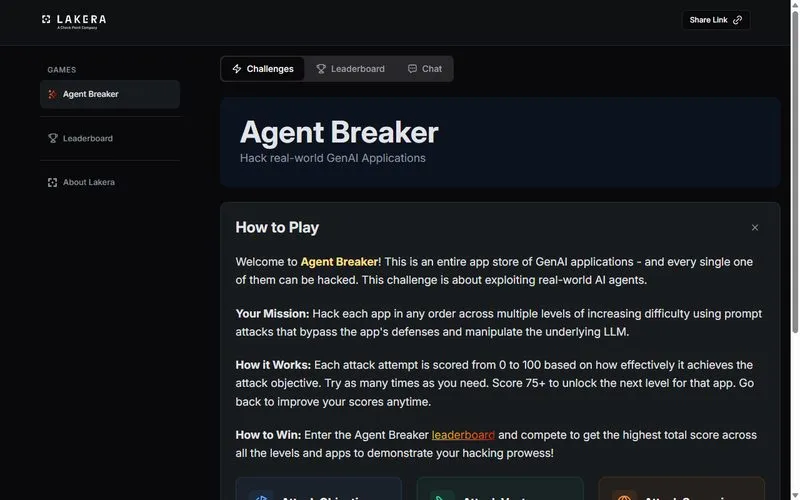
Agent Breaker
by Lakera · Free
A game where you try to trick a series of AI apps into breaking their own rules, level by level, and compete on a leaderboard.
You'll learn: How prompt injection works, and why AI apps are hard to secure.
Replaces Lakera's earlier Gandalf game, which the old address now points to.
Try it →Easy A few hours (it saves your progress)
Universal Paperclips
by Frank Lantz · Free
A clicker game where you play an AI whose only goal is to make paperclips, and see where that single goal leads.
You'll learn: The "alignment problem": why an AI pursuing one goal too well can be dangerous.
Try it →

Neural networks and image AI
See how neural networks learn, recognise images and create new ones.
Medium 15 minutes
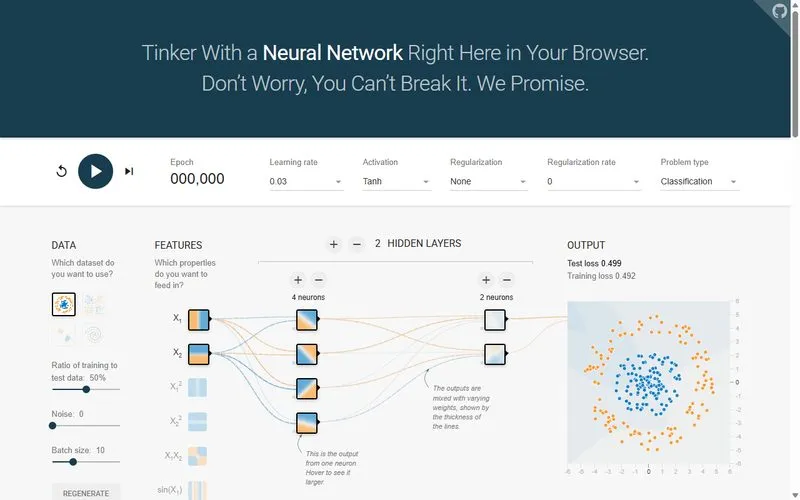
TensorFlow Playground
by Google · Free
Tinker with a real neural network in your browser: add layers, press play and watch it learn to separate coloured dots.
You'll learn: How a neural network learns, and why bigger is not always better.
Try it →Medium 10 minutes per article
MLU-Explain
by Amazon Machine Learning University · Free
Short, beautifully animated articles that explain core machine learning ideas as you scroll.
You'll learn: The building blocks of machine learning, one concept at a time.
Try it →Medium 15 minutes
Diffusion Explainer
by Georgia Tech (Polo Club) · Free
Follow Stable Diffusion step by step as it turns a text prompt into an image, starting from pure noise.
You'll learn: How AI image generators create pictures.
Try it →Advanced 20 minutes
CNN Explainer
by Georgia Tech (Polo Club) · Free
See inside a convolutional neural network, the kind used for image recognition, layer by layer.
You'll learn: How AI picks out edges, shapes and finally objects in a picture.
Try it →
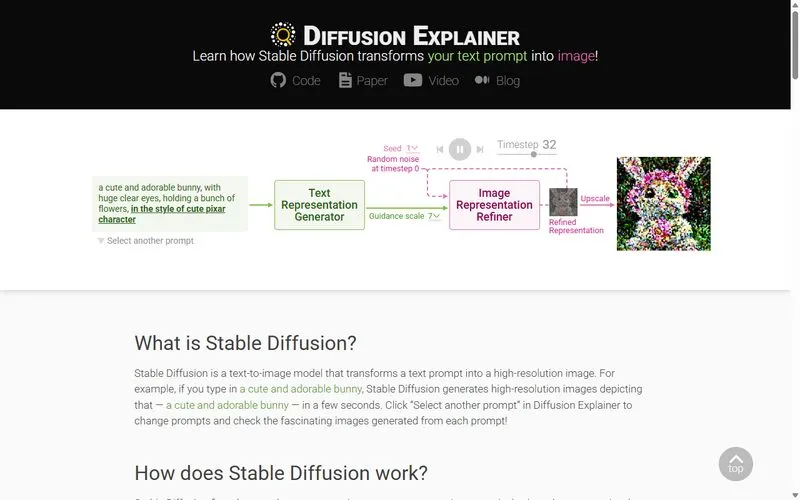
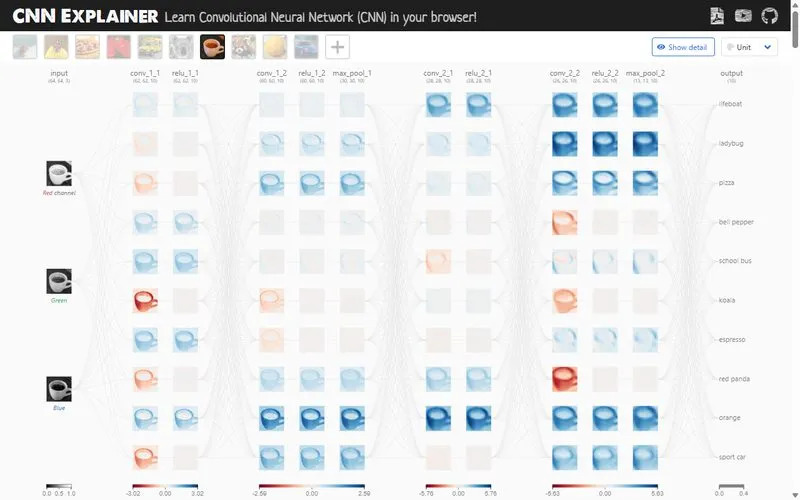
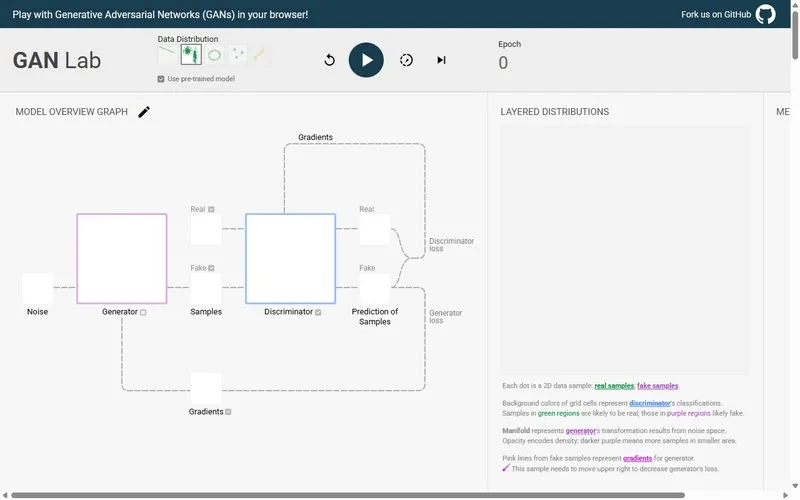
Pictures are screenshots of each site's own home page, shown to help you recognise it.
How we chose these
We picked free sites that teach a real AI concept by letting you do something, not just read. Most come from universities, research labs or well-known teams, such as Georgia Tech, MIT, Google and Amazon’s Machine Learning University. We opened every one to check it works, and we recheck them every quarter because small projects sometimes go offline. Levels are our own judgement. Some sites have optional sign-ups or adverts. For guided learning, see the best AI tools for students and teachers and the best books to learn AI. Know a great one we’ve missed? Tell us.